The Toxic Boss Survey is out, and the results are not good.
In our Toxic Boss era
Last week, my daughter graduated from kindergarten. During the adorable “moving up ceremony,” the class sang a song about what they want to be when they grow up.
Between choruses, they passed a microphone down the line of five and six year olds wiggling on the risers, and each student had a moment to share their vision for their future: “I want to be a ____.”
The most common answers among them were “Teacher” and “NBA player,” and the little boy who went for the full “Paleontologist” got some cute laughs. My daughter said “Builder,” which was a surprise to me, but she later explained that she could build a wall on which to paint a giant mural of rainbows and unicorns, and it all made sense.
There was another common response that stood out to me. It started with one energetic girl who grabbed the mic and yelled, “I wanna be a BOSS.” Several others down the line echoed her.
As a leadership coach, of course this struck me. I wonder what these littles have in mind when they envision themselves as bosses. Running a business? Being in charge? Telling people what to do? Getting paid a lot of money?
Making people’s lives miserable with their rampant power?
I wanna be a TOXIC BOSS!
Last month, The Harris Poll released its newest Toxic Boss Survey. Folks, the news is not good.
60% of American workers reported that their current boss exhibits harmful behaviors including: unfair preferential treatment, lack of recognition, blame-shifting, unnecessary micromanagement, taking credit for others’ ideas, unreasonable expectations, unprofessional conduct, and discrimination based on personal characteristics.
Some highlights from the report:
47% of workers with toxic bosses report increased stress, burnout, or decline in mental health
33% report that they’ve lost out on a financial reward or promotion
53% have sought out therapy to cope with the impact
What’s more: workers are feeling powerless to address toxic boss behaviors. 63% say that they’ve held back from going to HR for fear of being labeled as “too sensitive” or “not a team player.” Others hide or limit their visibility to keep the peace. (Interestingly, survey respondents from Gen Z were far more likely to report toxic behaviors to HR versus other generations, perhaps a sign of the future?)
Because today’s job market doesn’t favor employees, people are feeling stuck. 65% say they have to stay put and deal with their boss’ behavior, and 61% say that the second the economic climate improves, they’re out.
But there’s hope.
I’m an optimistic person at heart. I believe that those six year olds who boldly declared they “wanna be a BOSS” don’t aspire to be a toxic one. And I believe that your boss doesn’t want to be one, either.
In my experience, most leaders don’t intend to be toxic. They want to be a good boss. They're trying hard. But due to stress, insecurity, fear, and anxiety, their toxic behaviors bubble over and spill onto the people around them, most of all their direct reports.
One of my favorite teachers, Parker Palmer, says that leaders have the power to cast light or cast shadow onto the lives of others.
So what can we do to help them get it right?
The antidote to toxicity
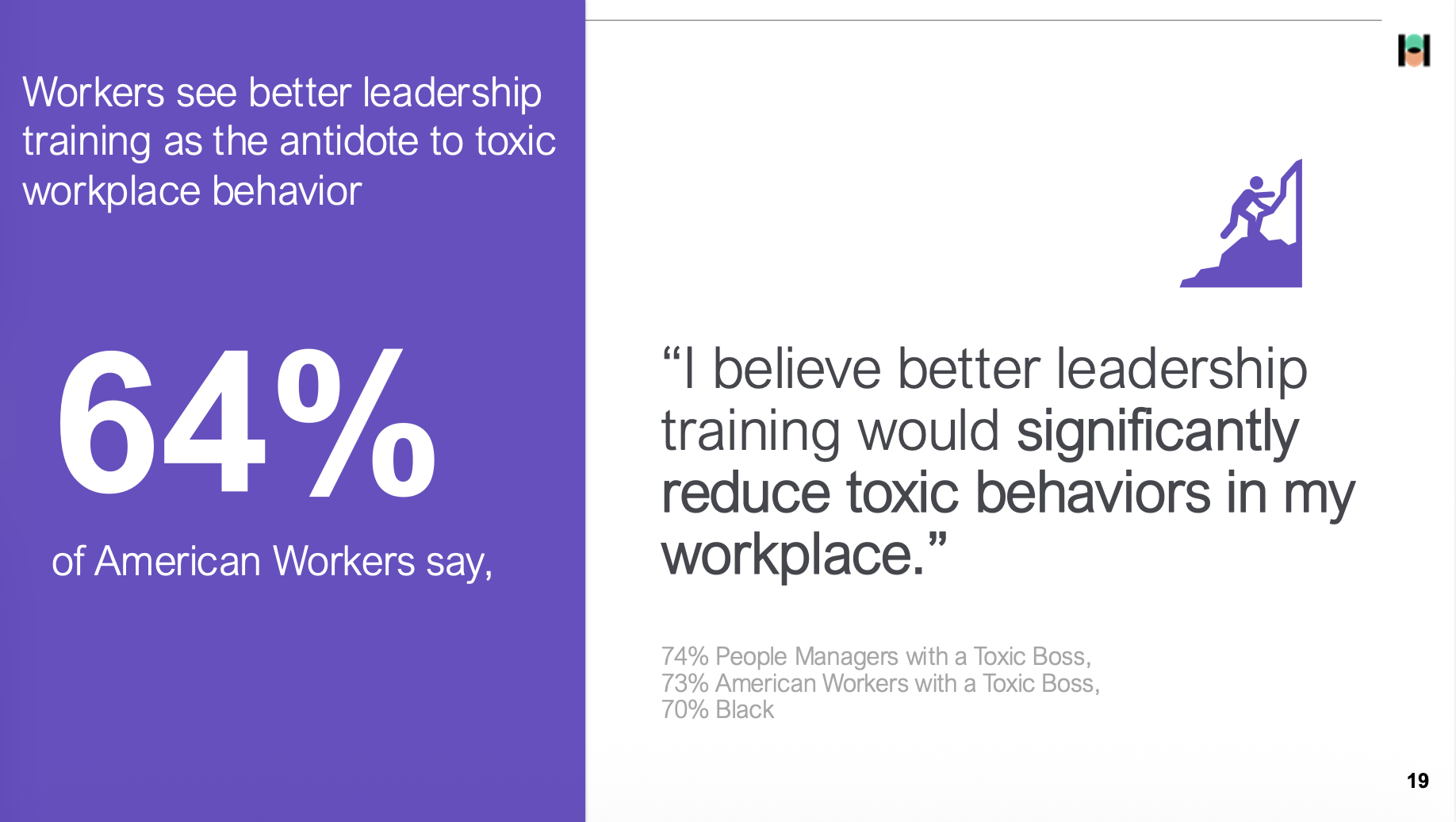
The most interesting part of the Toxic Boss Survey, to me, is that the respondents offered a solution: 64% of American workers say “I believe better leadership training would significantly reduce toxic behaviors in my workplace.”
Most of the leaders that I’ve worked through coaching or training found themselves in a leadership position due to one of three reasons:
They were a great individual contributor, which earned them a promotion to people manager.
They wanted to advance their career, and the only way to do that was by managing others.
Someone had to step up. Nobody else wanted to. So they did.
None of these reasons is ideal. The skills of individual execution are not the same as what it takes to support people. Career advancement is not the same as the genuine desire to lead others. And stepping up because you had to is no recipe for success.
In a perfect world, people would earn a manager role because they are good at their work but, even more importantly, great with people. They would care about people. They would believe in them, want to motivate and grow them. They would want to cultivate the kind of work environment that helps people bring their best self forward, contribute their skills, and collaborate with others to make an impact. That would actually sound like a fun and juicy challenge to them! They would receive training on how to do it as an emerging leader, where they would have opportunities to build their toolbox by managing a project team or intern. And they would have support in the form of training and coaching as they formally stepped into their people leadership role.
It hardly ever happens like that. But we can do that last part: we can give people the training and coaching support they need to be thoughtful and effective leaders right now. We can give them a space to reflect and grow so that they can make intentional and purposeful leadership moves—rather than reactive or insecure ones.
That's what I do when I coach leaders one on one.
The Toxic Boss Survey respondents asked for more support for their managers. And their managers agree.
The report shows that people managers are asking for practical leadership support. And the #1 thing on their wishlist? One-on-one coaching.
Investing in leadership coaching for managers is a game changer—for the leaders themselves, for their direct reports, and for company results. That’s why I do what I do.
We'll always need effective people leaders
The survey results are clear: there is a call for investment in leadership training and support.
The Chief Strategy Officer at The Harris Poll, Libby Rodney, explains:
“We’re in the largest technology investment cycle in a generation, and the human side of work is being left behind. Toxic leadership isn’t a character flaw – it’s an investment failure. These are today’s managers who were never trained or held to a standard, and now we’ve asked to lead through a transformation they weren’t equipped for before AI even arrived.”
Technology is hitting the workplace like a tsunami and its future remains unclear. But one thing is for sure: people leadership isn’t going anywhere.
There will always be humans at work, and they will always need clarity on roles and goals in order to produce great results. They will always need to be engaged and have opportunities for growth. They will always need someone to support them in that.
And there will always be six year olds and 19 year olds and 26 year olds and 38 year olds who wanna be a BOSS. Let’s help them be the good ones they intend to be.
* * *
One more thought: At the kindergarten ceremony, I was holding my breath for the one kid who didn’t throw out a profession at all, who said something like “When I grow up, I wanna be happy.” Nobody did.
Isn’t it interesting that in the year 2026, we’re still teaching our kids that their job title is the center of who they will become, instead of themselves and their character being the center of their world?
When my kids grow up, I don’t care about their job title. I want them to be kind, curious, resilient, and fulfilled. If that means painting murals of unicorns and rainbows, wonderful.
