
Why You Shouldn't Become a Manager
The job of a manager is to care for people. If that doesn’t excite you, let’s find you another role.
Last week, I wrapped up a 9-month leadership development program with managers at a global agricultural bank. As we looked back over all the topics they explored—from Trust to Paradoxical Thinking to Courageous Conversations and Customer Centricity, I asked the participants to share the most useful insight that they gained from the program.
When we got to Kacie, she laughed a bit as she said: “This is a funny insight, but what I realized is that I really like being a manager. I wouldn’t be as happy in a role that didn’t involve caring for a team.”
What a beautiful insight!
So many people are promoted into management roles for one of three reasons:
They’re a great individual contributor, and their performance earns them a step up.
They want to advance in their career, and the only way to do that is by becoming a people leader.
No one else is raising their hand, and somebody needs to take the lead.
While these reasons are common, they are completely disconnected from the purpose and reality of a management role.
Managers are the heart of an organization—translating organizational vision and strategy into real, practical work. They do that by caring for the organization’s greatest asset: the people carrying out the work.
Caring for people is the core activity of a manager. That involves:
Facilitating team meetings
Building a team culture of safety and support
Holding one on one meetings with each team member to learn about them as individuals, foster their goals, and clear obstacles getting in their way
If these things don’t excite you—if they feel more like an impediment to doing good work than the main vehicle for it—that’s okay. But you shouldn’t be a manager. Let’s find you an individual contributor role that allows you to shine.
Here's what organizations need to do to make that possible: Traditional work structures support a simplistic, linear narrative that your career track will look like this:
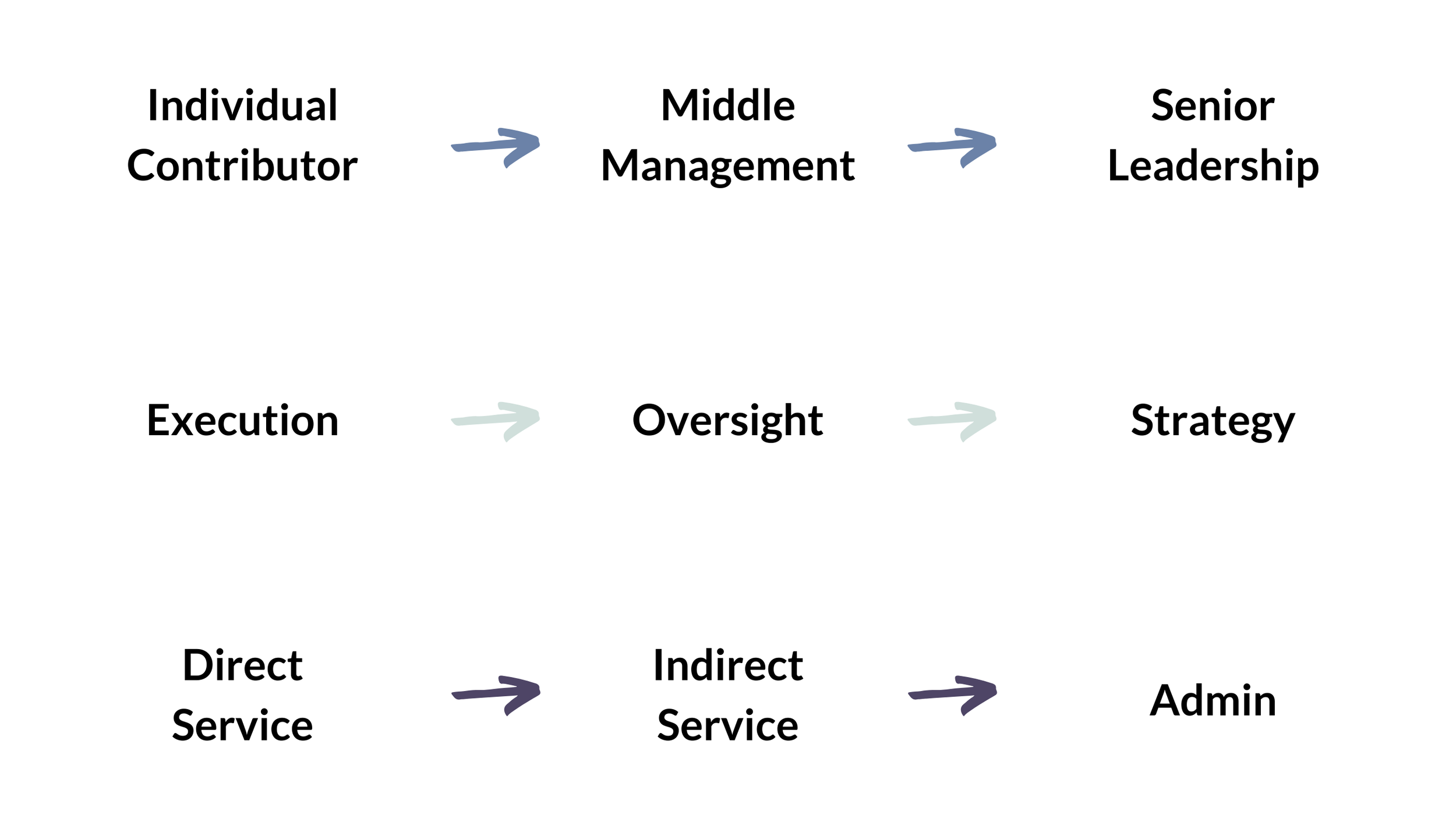
But in reality, we each have a different sweet spot. We don’t all aspire to be an executive working on strategy at the administrative level. We need a different model for advancement.
Organizations need to do more to build creative pathways for growth within each of these role types—especially for individual contributors. IC’s need ways to advance and make an impact without becoming people leaders if that is not their skill set or interest.
Organizations also need to provide real coaching and training for those stepping into people leadership—instead of expecting new managers to intuitively understand how to support people, we need to teach them real skills and give them the space and support to integrate those skills into their daily work.
Just like this 9-month program did for Kacie.
I’m so glad that Kacie is fully embracing her role as a manager. And if another manager came out of the program thinking, “You know what? This is really not for me!” then I believe that is a positive outcome of the program as well.
We need the people who care about caring for people to take on management roles, and organizations that will support them in doing that.
Too many of us have worked for managers and organizations who do neither. At best, they miss an opportunity to perform at a greater level. At worst (and this is often what I see), they do real harm to real people—either the new managers who are drowning in the skill gap between their good intentions and their actual skill, or the professionals who report to them. I have been both.
That’s why I do what I do: I coach a train leaders to show up with purpose, skill, and the range to meet challenges with the right tool in the right moment.
